
1. Start with the label
The label in the collar or on the side seam says a lot about the age of a shirt. Old labels are often simpler than today's: a brand name, a size and washing instructions, nothing more. Modern shirts usually have several labels with product codes, barcodes or QR codes.
Then look up the product code and compare it with photos of the original shirt on archive sites or in collectors' groups. If the code does not match, or you cannot find a shirt with that code anywhere, be careful.
2. Seams and stitching
Look at the inside of the shirt. Neat, even stitching and solid seams belong to a well-made shirt. Also look at how the collar and cuffs are finished: on older shirts these are often separate, knitted pieces.
Loose threads, uneven loops or a different fabric weight are not proof of a fake, but they are a reason to take a good look at the rest of the shirt.
A shirt that is thirty years old always shows its age. That is not a flaw, that is the point.
3. Badges and sponsor prints
On older shirts the club badge and the sponsor name are often ironed on or embroidered. After years of wear and washing, an ironed-on print can be slightly cracked or discoloured. That comes with age. A print that looks new and glossy on an otherwise worn shirt is something to watch out for.
 Very goodL
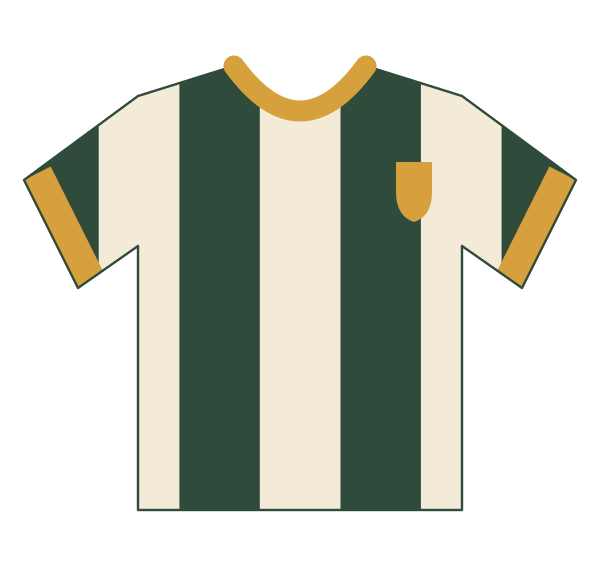
FC Voorbeeld 1996/97 away
€64.00
4. Original or reproduction?
A reproduction is not necessarily bad, but you do want to know what you are buying. This table helps you on your way. These are guidelines, not guarantees: the more points you can tick off, the greater the chance of a genuine vintage shirt.
| Feature | Often original | Often reproduction |
|---|---|---|
| Label | Simple, with brand, size and washing instructions | Several labels, barcode or QR code |
| Stitching | Sturdy, slightly uneven after years of wear | Very tight, or on the contrary sloppy and loose |
| Fabric | Thicker polyester or cotton, soft from wear | Thin, smooth and airy sportswear fabric |
| Light cracks or fading fit the age | New and glossy on an otherwise worn shirt |
5. Frequently asked questions
Frequently asked questions
How old is vintage?
A shirt is usually called vintage when it is at least twenty years old. With us it is mostly shirts from the 1980s, 1990s and early 2000s.
Are your shirts original?
We do not give an official guarantee of authenticity, because hardly anyone can do that with old shirts. What we do is check what there is to check: label, stitching, prints and season. If we say a shirt is original, we stand behind that. If we doubt it, you will read that with the shirt.
Is a cracked print acceptable?
On a shirt thirty years old, a slightly cracked or partly worn print is normal. What matters is that it is described honestly and shown in a photo. With us, every flaw is in the condition of the shirt.
Can I have a shirt checked?
Unsure about a shirt? Email us photos of the label, the care label, the stitching and the print. We will look with you and say honestly what we see and what we do not. We cannot give an official certificate of authenticity.